The Men of North Royal Street

When I was looking at data from the 1920 U.S. Census for Alexandria, something that seemed interesting to me was a group of six Greek immigrant men who all lived together on North Royal Street and had immigrated within the same five year time period, 1910-1915. John Demos, Chris Thomas, James Thomas, Thomas Demos, and Louis Rams were all roomers in the same house. And–they were all waiters in a lunchroom. As we learned from Demetrios is Now Jimmy, many Greek immigrants worked in the restaurant industry in the U.S. South, sending that money home to support their families.[i] Eventually, they planned to return home to Greece once they had made enough money. Another piece of evidence from the census that supports that theory is the group of men living and working together, are all single and around the same age. They did not travel with any older family members, and they did not travel at an age where they were too young to work or too old to travel back. Being from Greece, they were still attached to their homeland because they did not leave via religious turmoil. like Jewish immigrants from Eastern Europe at the same period.

By the beginning of the twentieth century, Greek immigrants had started businesses in Alexandria’s food industry and employed other Greek immigrants, often friends or family members. Although speaking English was not necessarily required in the food industry, it could be helpful. Looking at the 1920 U.S. Census, all six of the men could read, write, and speak English, all of which would be helpful working in Alexandria.

The 1920 U.S. Census was extremely interesting because it showed that Greek immigrants lived and worked together.

[i]  Larry Odzak, “Demetrios Is Now Jimmy”: Greek Immigrants in the Southern United States (Durham, NC: Monograph Publishers, 1997), 10-29.

Charles Freeman

7 W Myrtle

The 1940 home of the Freeman family, 7 W Myrtle Street.

The Freeman family at the end of Ward 5 in the 1940 U.S. Census caught my eye. The first thing I noticed was that it was a widowed father living with his grown single children renting 7 North Myrtle Street (which must be West Myrtle Street as there is no North Myrtle). Charles Freeman Sr. was born in Mantiania, Greece circa 1889 based on his age in 1940 and immigrated to the U.S. most likely in the early 1900s while he was in his 20s.[1] It was ideal for Greek immigrants to come to the U.S. earlier before the passage of the 1924 National Origins Quota Act made immigration for Greeks and many other nationalities more difficult. His reasons for coming to the United States are unclear, but, like most other Greek men his age, he probably came for work with the intention of returning home after earning enough money. His early immigration could also account for his Americanization of his name as he was trying to adapt to his new environment as quickly as possible.

Charles Freeman moved to Alexandria in 1938 with his wife, Hilda, and five children; Charles Jr., George, Donald, James, and Maxine.[2] The 1940 U.S. Census for Alexandria states that all five of his children were born in New Castle, Pennsylvania suggesting that after immigrating from Greece, Charles settled there, married Hilda relatively soon after, and started a family. Hilda died on June 13, 1939 and is buried in Saint Mary’s Catholic Church Cemetery in Alexandria. Details about Hilda’s life prior to Alexandria show that she was an active member of the New Castle community as a member of the woman’s group, the Windsor Girls, as early as in 1907 and hosted group meetings at her home on Harbor Road.[3] She was also an avid card player, and she won a prize for a card game in 1934.[4] The details surrounding Hilda’s death are unknown, but she left behind a husband and five grown children.

Freeman Draft Card

Charles Freeman Sr. World War II draft card.

Alexandria in 1940 presented several opportunities for Charles and his children, two of whom had graduated college; the other three, Donald, James, and Maxine, were high school graduates. As the United States was preparing for possible involvement in World War II, thousands of new jobs in the government and other industries were created. These jobs attracted people to the DC metro area not only for the jobs in the government, but also for the jobs that were created to sustain theses newcomers. Most Greek immigrants in the 1940 U.S. Census were continuing their tradition of owning and operating restaurants or other food industry related jobs. Recognizing the need for quick and easy food for the region’s growing labor force, Greek immigrants quickly adapted to their role as restaurateurs. Charles Freeman went against the norm among Greek immigrants. His occupation in the 1940 U.S. Census was listed as an owner of a movie theater. Charles’ World War II draft card reveals that he owned the Lido theater at 3227 M Street in Georgetown.[5] By 1942, Charles is listed at 913 Bashford Road in Alexandria with all but James still living at home; he was still the owner and manager of the Lido.[6]

The last known address of the Freeman family, 913 Bashford Rd.

The last known address of the Freeman family, 913 Bashford Rd.

Charles’s unconventional job also affected his children. Most children of Greek immigrants work in the family restaurants; however in the case of Charles’s family, his children pursued their own careers. All of his children have their own careers in the 1940 U.S. Census and in the 1942 city directory except Donald. Donald, in 1942, continued the Greek American tradition of working in the family-run business by managing a movie theater; this job is quite different from the one listed in the 1940 census, which was a brakeman at Potomac Yard.[7] The 1942 City Directory does not list the theater that Donald works at, but it can be assumed that it is the Lido theater his father owns.

Charles Freeman died in 1951 in Alexandria and the last of his children, Maxine, passed away in 2014.  He is survived by numerous grand and great-grandchildren.[8]

[1] Charles Freeman World War II Draft Card, 1942; ancestry.com, (accessed October 8, 2015).

[2] “Maxine M. Knight,” Daily Press Obituaries, http://www.legacy.com/obituaries/dailypress/obituary.aspx?pid=171922051 (accessed October 1, 2015).

[3] New Castle Herald, April 24, 1907, http://www.newspapers.com/newspage/96842821/, 6.

[4] New Castle News, November 8, 1934, http://www.newspapers.com/newspage/73573578/, 6.

[5] Charles Freeman World War II Draft Card, 1942; ancestry.com, (accessed October 8, 2015).

[6] Hill’s Alexandria City Directory (Richmond, VA: Hill Directory So, Inc., Publishing, 1942), 156; ancestry.com, (accessed October 8, 2015).

[7] Ibid.

[8] “Maxine M. Knight,” Daily Press Obituaries, http://www.legacy.com/obituaries/dailypress/obituary.aspx?pid=171922051 (accessed October 1, 2015).

Isaac Eichberg

When reading a census, one really wants something to jump out, and Isaac Eichberg was that for me. According to the 1870 U.S. Census, he was the head of household of a family of six in Alexandria, Virginia’s First Ward. He also happened to be a “lumber dealer,” and a successful one at that with $19,000 worth of personal property and real estate. His total property is what stuck out to me; this value was the greatest of any German-Jewish immigrant I came across in Alexandria in the 1870 and 1880 U.S. Census. My interest began when I could not find initially find Eichberg in the 1880 U.S. Census. His grave in Home of Peace Cemetery, which is also in Alexandria, has his death occurring in 1914. So where did Eichberg and his family go?

 eich

Some digging in Chronicling America database of newspapers yielded multiple results for Eichberg that helped me track his life in Alexandria. On May 25, 1872, his name was mentioned as one “of the successful candidates…” for city council in the First Ward of Alexandria in the Evening Star, a regional newspaper published in Washington, D.C. [1] So clearly he was still living in the area, and presumably the same house. The Evening Star marked his election again in 1879, but this time to the position of aldermen.[2] Eichberg appeared two more times in 1883 and 1885 in the press.[3]  During these years, he was elected President of the German Banking Association and German Building Association.[4]

After 1885, Eichberg’s name appeared numerous times in the Alexandria Gazette through advertisements for his dry goods store located at the Corner of King and Royal Street, just a few blocks from the river.[5]  He clearly was a prominent figure in the Alexandria community and still active in the area. So again, the question arises, where was he in the 1880 U.S. Census?

 eee

After calling in some assistance from Professor Krystyn Moon, I found Eichberg in a different section of the 1880 U.S. Census (the ward was in two sections). Unfortunately, the census did not include his house number, but it did have him on Cameron Street in the Third Ward, putting him on the west side of Washington Street. The census also noted eight children living with Eichberg, four more than in 1870. Eichberg’s job is also listed as dry goods merchant this time, instead of lumber dealer, which correlates to articles and advertisements in the 1880s.

Because of his prominence, a local reporter wrote a rather lengthy obituary in 1914.[6] Reference to his home at 114 North Washington Street was made by the author. It is possible that this is the same home described in the 1880 census because the address is very close to Cameron Street on the Third Ward side. The obituary is very adoring and complementary of Eichberg, making apparent how much he was a prominent figure in the community.

I found it quite fun investigating Eichberg and learning about an influential member of the Alexandria community he was.

Image Sources:

Photo 1- “Isaac Eichberg Photo,” The Institute for Southern Jewish Life, http://www.isjl.org/virginia-alexandria-encyclopedia.html (accessed 9/24/2015).

Photo 2- “Isaac Eichberg and Son,” Alexandria Gazette, November 4, 1899, http://chroniclingamerica.loc.gov/lccn/sn85025007/1899-11-04/ed-1/seq-3/, (accessed 9/24/2015).

Footnotes:

[1]-“Alexandria,” Evening Star (Washington), May 25, 1872, Accessed 9/24/2015, Chronicling America.

[2]-“The Alexandria Elections,” Evening Star(Washington), May 23, 1879, Accessed 9/24/2015, Chronicling America.

[3]-“Alexandria,” Evening Star(Washington), March 8, 1883; “Alexandria,” Evening Star (Washington), January 8, 1885, “Accessed 9/24/2015, Chronicling America.

[4]-“Alexandria Affairs,” Evening Star (Washington), January 3, 1885, Accessed 10/1/2015, Chronicling America.

[5]-“Dry Goods,” Alexandria Gazette, January 27, 1890, Accessed 10/1/2015, Chronicling America.

[6]-“Funeral Services For Isaac Eichberg,” Washington Times, November 9, 1914, Accessed 9/24/2015, Chronicling America


The Bendheim Family

While digging through the data from the 1870 U.S. Census for Alexandria’s 3rd Ward, I came across David Bendheim and his wife, Fanny Lauer Bendheim, and their family. While looking at the information on their household, I realized they must have been one of the more wealthy immigrant families at the time. This made me want to dig deeper into their family history.  Using census data and other reliable internet sources, I was able to piece together information about members of the Bendheim family during the mid-to-late nineteenth century.

The Bendheims were a middle-class, German Jewish family who had emigrated from Baden to become successful merchants in Alexandria.[1] The Bendheims lived on the 500-block of King Street, in the middle of the central business district.[2] As the Alexandria census data in 1870 shows, David Bendheim became a dry goods merchant while his wife Fanny’s occupation was keeping house.  The census data also shows that they were a middle-class family, having a combined property of $1,500.[3] In the 1880 U.S. Census, the Bendheims had moved to Ward 2, but were still working as dry goods merchants.[4]

David and Fanny’s children also went on to play important roles in Alexandria society. The Bendheims’ daughter, Rachel, married Max Pretzfelder. Pretzfelder was also a prominent dry goods merchant in the 500 block of King Street.[5] The Bendheims’ son, Charles, had a career in politics in Alexandria. He became a member of City Council, Clerk of the Courts, and a Virginia Assemblyman. An article from the Evening Star in 1905 shows his election as Clerk of the Courts. Charles ended up marrying Edith Schwartz.[6]Her father, Isaac Schwartz, was also merchant in Alexandria.[7]

Bendheim Evening Star article on the election of Charles Bendheim to Clerk of the Courts from Chronicling America

Continuing generations of Bendheims also had played important political roles in Alexandria, Virginia.  When David and Fanny Bendheim came to Alexandria from Baden, they started a prominent family that continues to impact Alexandria today.

1. Amanda Iacobelli, “German and German-Jewish Immigrants: Michael German, Lewis Baar, David Bendheim, Max Pretzfelder, J. H Gerhard, and Henry and Isaac Schwarz,” accessed September 16, 2015, http://alexandriava.gov/uploadedFiles/historic/info/archaeology/AR500BlockGerman.pdf.

2. Ibid.

3. 1870 US Census; Alexandria, Virginia.                                                                                                                                                            

4. 1880 US Census; Alexandria, Virginia.                                                                                                                                                    

5. Iacobelli, “German and German-Jewish Immigrants.”

6. “Alexandria Affairs,” The Evening Star, September 15, 1905, Chronicling America, accessed September 16, 2015.

7. Iacobelli, “German and German-Jewish Immigrants.”

Who is Charles Bendheim’s Father

When I began my research, I was going to focus on Charles Bendheim and his wife, Edith . The focus was going to be on German-Jewish immigrants marrying within their ethnic and religious community when I came upon some conflicting evidence. I then read “German and German-Jewish Immigrants: Michael German, Lewis Baar, David Bendheim, Max Pretzfelder, J. H Gerhard, and Henry and Isaac Schwarz” by Amanda Iacobelli is where I originally found out that Charles Bendheim married Edith Schwarz and both their parents’ were German-Jewish immigrants.¹ The article says that Charles Bendheim was the son of David Bendheim. This information conflicted against the 1870 U.S. Census for Alexandria, Virginia where I could not find Charles Bendheim in the Bendheim family. Charles was supposedly born in 1866, which would have made him four years old. After further research on findagrave.com, I was able to locate Charles Bendheim, and that website revealed that Charles’s father and mother were Leopold and Caroline Bendheim.² This was confirmed after discovering on the 1870 U.S. Census that there was in fact a Charles Bendheim who was four years old, and the head of the household was Levi (which I believe was supposed to be Leo) Bendheim married to a Caroline.

Photo of Leopold Bendheim (Courtesy of Institute of Southern Jewish Life)

Photo of Leopold Bendheim (Courtesy of Institute of Southern Jewish Life)

The fact that David Bendheim was not Charles Bendheim’s father may seem small; however, this brought the whole document from Alexandria city government that I found into question. It brought up questions of legitimacy on the rest of the document. I think this is a great reminder to any researcher to make sure that they use multiple sources to ensure that what they find is accurate and correct in order for them to publish accurate and credible information. The last thing a researcher would want to do is publish something that was wrong, because they did not do there due diligence to ensure that their information they were collecting was accurate.

Citations

1.Amanda Iacobelli. German and German-Jewish Immigrants: Michael German, Lewis Baar,
David Bendheim, Max Pretzfelder, J. H Gerhard, and Henry and Isaac Schwarz. Accessed September 24, 2015.
http://alexandriava.gov/uploadedFiles/historic/info/archaeology/AR500BlockGerman.pdf

2.“Charles Bendheim.” Find A Grave. Last modified December 27, 2014. Accessed September 24,
2015. http://www.findagrave.com/cgi-bin/fg.cgi?page=gr&GRid=140554061

Works Cited

Iacobelli, Amanda. German and German-Jewish Immigrants: Michael German, Lewis Baar,
David Bendheim, Max Pretzfelder, J. H Gerhard, and Henry and Isaac Schwarz. Accessed September 24, 2015.
http://alexandriava.gov/uploadedFiles/historic/info/archaeology/AR500BlockGerman.pdf

“Charles Bendheim.” Find A Grave. Last modified December 27, 2014. Accessed September 24,
2015. http://www.findagrave.com/cgi-bin/fg.cgi?page=gr&GRid=140554061

“Encyclopedia of Southern Jewish Communities – Alexandria, Virginia.” Institute of Southern
Jewish Life. Accessed September 24, 2015. http://www.isjl.org/virginia-alexandria-encyclopedia.html

Simon Waterman

Simon Waterman’s entry in the 1870 U.S. Census for Alexandria, Virginia makes it clear that he was doing quite well for himself. The Bavarian immigrant owned a clothing store, and had a combined property value of $4,500. Waterman’s large family also caught my attention. With his wife, Caroline, a fellow Bavarian who was thirteen years his junior, Simon fathered an impressive nine children. After further research, I was disappointed to find very little information about Simon and the Waterman family was readily available online. However, Simon’s loyalties to the South during the Civil War left a record that I was able to explore.

Union troops occupied Alexandria starting in May 1861, and citizens who were thought to be disloyal to the Union were subject to investigation. All Alexandrians were required to prove his or her allegiance to the Union.[1] If they could not do this, they were forced to leave the city. The Union originally intended the Oath of Allegiance to be required for military and government personnel, but as the war continued, it was also applied to business owners such as Simon.[2] Simon and Caroline Waterman appeared in the provost marshal’s records as two Alexandrians . It is noted that Simon associated with rebels but was “guarded in conversation.”[3] Simon initially refused to declare his loyalty and would have been deported in June 1863 along with Caroline and several fellow merchants. However, the Watermans narrowly avoided this situation when the Secretary of War rescinded the order of deportation.[4] Simon signed an Oath of Allegiance to the Union on July 9, 1863.[5] There were many versions of the Oath of Allegiance, as it evolved during the course of the Civil War. The Alexandria Library has several examples of the Oath, but it is unclear which version Simon would have signed.[6]

After the Civil War, Simon Waterman further integrated into white, southern society, and was elected to the city Common Council in 1870.[7] He appears in the 1880 U.S. Census, living on East Royal Street with Caroline and four of their children. Their son, Josiah (listed as J.H.) evidently joined his father in the clothing business, as he, too, is listed as a “dealer in clothing.” Simon died in 1882, but Caroline did not pass away until 1905. Both are buried in Home of Peace Cemetery along with their son Inman, who died in 1863 at the age of three.[8] Presumably, their children who survived childhood moved away from Alexandria and were buried elsewhere.

Through researching Simon Waterman, I was able to discover more information about the occupation of Alexandria during the Civil War. I was not aware that so many business owners were pressured into signing the Oath of Allegiance to the Union. It also gave me an interesting glimpse into the lives of Southern Jews who supported the Confederate cause. Only after being nearly deported did Simon choose to sign the Oath of Allegiance. German Jews who settled in the South were often eager to adopt local customs in order to gain approval from Southerners.[9] For a businessman such as Waterman, it would be particularly advantageous if he appeared to assimilate in every sense. He risked losing white customers if he did not support the Confederacy. Keeping this information in mind, did Simon resist signing the Oath of Allegiance out of a desire for acceptance, or did he hold out because he truly believed in the Confederate cause? Southern Jews tended to support the Confederacy both out of loyalty to their adopted society and to Jewish tradition.[10] Southern Jews who supported the Confederacy were certainly in the majority, so it would make sense for Simon to be one of them. Most likely, he resisted signing the Oath out of genuine loyalty to the Confederacy, while also knowing that doing so would make a statement to his white (and black) neighbors. Signs of loyalty by Southern Jews during the war helped to ensure postwar success and white acceptance in post-war Alexandria, and Simon Waterman enjoyed the fruits of his resistance to the Oath.

[1] “Encyclopedia of Southern Jewish Communities-Alexandria, VA,” Institute of Southern Jewish Life, 2014, Accessed September 23, 2015, http://www.isjl.org.

[2] “Oath of Allegiance in Virginia, 1862-1865,” Alexandria Library, 2015, Accessed September 22, 2015. http://www.alexandria.lib.va.us/client/en_US/home/?rm=OATH OF ALLEGI0|||1|||0|||true.

[3]  Melvin I. Urofsky, “Virginian Jews in the Civil War.” Jewish Life in Mt. Lincoln’s City,” Accessed September 22, 2015, http://www.jhsgw.org/exhibitions/online/lincolns-city/exhibits/show/mr-lincolns-city/essays/urofsky

[4] Ibid.

[5] “Oath of Allegiance, May 1862-1865,” Alexandria Library Genealogy Resources, Accessed Septermber 22, 2015; http://www.alexandria.lib.va.us/custom/web/lhsc/genealogyresources/oath/OATH_alpha.html

[6] Ibid.

[7] “Encyclopedia of Southern Jewish Communities-Alexandria.”

[8] Find A Grave: Home of Peace Cemetery, Accessed October 1, 2015, http://www.findagrave.com/cgi-bin/fg.cgi?page=cr&CRid=2183655.

[9] Robert N. Rosen, “Jewish Confederates,” in Jewish Roots in Southern Soil: A New History, ed. Marcie Cohen Ferris and Mark I. Greenberg (Lebanon: University Press of New England, 2006), 111.

[10] Ibid, 116.

Beth El Hebrew Congregation

After our discussion this week, I became very interested in the Beth El Hebrew Congregation. I was curious about its establishment, their involvement in the Alexandria community, and their role in creating the Home of Peace Cemetery. The cemetery is one of the earliest Jewish cemeteries in Virginia. Its founding is the result of the establishment of the Hebrew Benevolent Society in 1857 to establish a proper burial ground for the members of the Beth El Hebrew Congregation. Most of the Jewish community’s wealthiest and most prominent families were buried in Home of Peace, including members of the Strauss, Bendheim and Dreifus families whom we discussed in class.

German Jewish immigrants had been arriving and settling in Alexandria since the 1830s, and by 1856 more than 30 Jews were residents of Alexandria. Despite the early establishment of Home of Peace, it was not until 1871 that the Beth El Congregation decided to find a permanent place of worship and establish a religious school for the 20 or so families that made up the congregation (NOTE: it was considered a “family congregation” from 1883 to 1938). Beth El was a reformed congregation, and starting in 1871, sermons were delivered in English. Beth El, like congregations in Charleston, Richmond, and Savannah, practiced what became known as American Reform Judaism. English during sermons, the use of pews, the desegregation of the sexes, and the use of organs during service were some of the ways Jews, especially in the South, attempted to change their services to appeal to younger and more acculturated members. The reforms were also in response to the tension fueled by nativism, and a general resentment that non-Jewish Southerners felt after after the Civil War.  Jewish communities continually tried to prove their patriotism to the South, and appear more “American” by supporting Southern causes and reforming one of  the few things that made them stand out: their faith.[1]

The congregation had been an active member of the Alexandria community since its start. Most of the earliest members of the congregation were participants in the business community, working mostly in retail trade, including dry goods, clothing, shoes, groceries, and scrap. In my research on Beth El, I found an article from Alexandria Gazette that reported on their Yom Kippur celebration in 1863.[2] 73eaa9e510734a1874ff36820c8e1857The article talks about the celebration, and mentions that the shops and businesses owned by the Jewish community would be closed for the holiday. This shows how much of an important part German-Jewish businesses played in Alexandria. So I did a little more digging using the Chronicling America site, and found another announcement from the Alexandria Gazette similar to the Yom Kippur article, only this time about the Hebrew New Year. [3] Similarly, it also talks about shops being closed for the holiday, both those of the reformed and orthodox faith. It also provides a little information on the holiday and its practices, like the announcement for Yom Kippur. Hebrew New Year is also known as Rosh Hashanah, which occurs ten days before Yom Kippur. They are a part of a series of Jewish holidays known as “Yamim Noraim” or the “Days of Awe.” The two holidays are the “High Holy Days” in Jewish religion.[4]

Beth El was such an active participant of the Alexandria community that it was necessary to report on their holidays and events because they were of interest to everyone else. Despite the very small size of the congregation, their businesses were of great importance to the rest of Alexandria because they supplied the community with so many goods and services. Knowing when Jewish holidays were was essential for the community so they would know what days to shop.

[1] Beth El Hebrew Congregation, History, https://www.bethelhebrew.org/about/history (accessed September 16, 2015); Gary Phillips Zola, “The Ascendancy of Reform Judaism in the American South During the Nineteenth Century,” in Jewish Roots in South Soil: A New History, ed, Marcie Cohen Ferris and Mark I. Greenberg (Lebanon, NH: University Press of New England, 2006), 156-191.

[2] “Yom Kippur,” Alexandria Gazette, September 23, 1863.

[3] “The Hebrew New Year,” Alexandria Gazette, October 3, 1891.

[4] “Rosh Hashanah,” accessed September 30, 2015, http://www.history.com/topics/holidays/rosh-hashanah-history

The Strauss and Bendheim Families

After sifting through the 1870 and 1880 U.S. Census data from Alexandria, Virginia and discussing some trends as a class, I have decided to take a closer look at two German Jewish immigrant families: the Bendheims and the Strausses. In looking at these two families, I aim to focus on the relationship between them and how migration to Alexandria either created or maintained family ties.

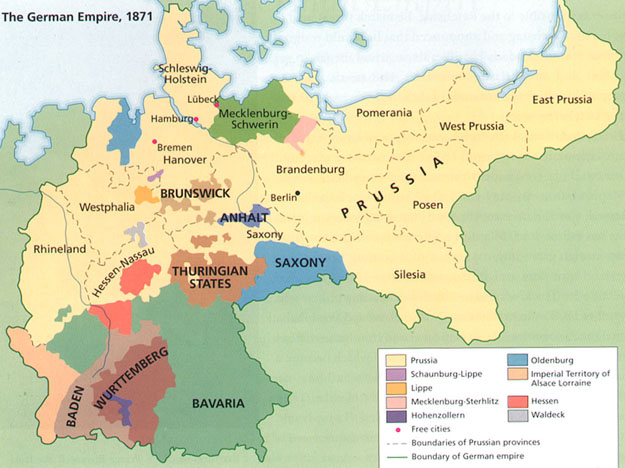
Looking at “Germany” in 1870 is not a necessarily straightforward task, as the nation of as we know it today did not exist. Instead, the country was broken up into several kingdoms, which often centered around a particular city (see map 1).¹

(Map 1:The German Empire: 1871.)

However, a year later, Otto von Bismarck began the process of unification, a goal that many Germans had embraced in the nineteenth century. Like the majority of German immigrants, the Bendheim and Strauss families did not claim to be from a unified Germany in the U.S. Census. In 1870, the Strausses all claimed to be from Bavaria, the large region encompassing much of southeastern Germany today. Likewise, the Bendheims migrated from the region known as Baden, which borders Bavaria to the southwest. By claiming these regional identities, both families show that most Germans still held to the more local identifiers and did not claim to be from Germany. When the census taker came back in 1880, these same Old World identities were not used by all members of the family. Despite the unification of these former regions and city-states under one German government, the Bendheim and Strauss families still clung to their local identities. In 1870, Emma Strauss claimed to be from Bavaria, but in 1880 the census taker wrote that she hailed from the Darmstadt, a city located in the former territory of Hessen. Similarly, David Bendheim claimed to be from Baden in 1870, but his allegiance also switched to the city of Darmstadt. Fanny Bendheim also switched from claiming to be from Baden in 1870, to claiming to be Bavarian in 1880 (see Table 1). These changing ideas of identity and where exactly they were from tell a lot about the changing nature of ethnic identity among German immigrants, including German-Jewish ones, in this ten year window. A possible explanation for these changing identities could be that the census taker was not very thorough in the recording of his data in one or the other year. Another possible answer could be that these places are close geographically. And–another reason could be that, while Baden and Bavaria still existed as regions in Germany, their cultural, social, and political importance as ethnic identities was drastically lessened after the unification of Germany. The City of Darmstadt still certainly significance, but mostly on the local level.

Table 1: Nation of Origin among the Bendheim and Strauss Families, 1870 and 1880

Name/Year of Census Region of Germany Ward in Alexandria Occupation
Henry Strauss/1870 Bavaria Ward 3 Dry Goods Merchant
Henry Strauss/1880 Bavaria Ward 2 Dealer in shoes & clothing
Emma Strauss/1870 Bavaria Ward 3 Keeping House
Emma Strauss/1880 Hesse Darmstadt Ward 2 Keeping House
David Bendheim/1870 Baden Ward 3 Dry Goods Merchant
David Bendheim/1880 Hesse Darmstadt Ward 2 Dry Goods Merchant
Fanny Bendheim/1870 Baden Ward 3 Keeping House
Fanny Bendheim/1880 Bavaria Ward 2 Keeping House


While looking at these two families and the table above, it is also interesting to note the ways in which the Strauss and Bendheim families moved within the City of Alexandria. The Strausses and Bendheims came from the same region–although different kingdoms–in Germany, and then settled in the same ward.  In 1880, they then moved to the same ward again. Given all these factors, it would seem that the Strauss and Bendheim families either knew each other in Germany, or became fast friends once they arrived in Alexandria. Documents show that David Bendheim and Henry Strauss were members of the same congregation and served on its Board of Trustees.² They were also both members of the Hebrew Benevolent Society in Alexandria. Perhaps, it was these ties that led them to move together from Ward 3 to Ward 2?


(Map 2: Alexandria Country, Virginia: 1878. The area highlighted in green shows the City of Alexandria.)

Still other explanations do exist for the possible movement of the families within Alexandria. The above map of Alexandria in 1878 shows what was then the City of Alexandria in the bottom right corner, highlighted in green.³ The wards are numbered by splitting the City into four quadrants with Washington and King streets serving as the two axes. The bottom right quadrant is Ward 1, the top right is Ward 2, the top left is Ward 3, and the bottom left is Ward 4. The fact that both the Strauss and Bendheim families lived in Ward 3 in 1870 could very well be explained by the occupation of Henry Strauss and David Bendheim. As dry goods merchants, both men would have found a ready market of customers in Ward 3 due to its proximity to the train tracks. People would flow in and out of this part of town frequently, particularly earlier on in the Civil War, providing both men with a broad client base. This would also mean though, that housing in Ward 3 was likely poor, and while proximity to the rail road could be good for business, it is not the ideal spot for your home. The census taker in 1870 valued both David and Henry’s properties at $1,500, very respectable, but fairly poor compared to some of their fellow German Jews. As both families began to grow their businesses and earn more money, this could be one reason why both families picked up and moved to Ward 2 sometime between 1870 and 1880. Another reason could be that moving to Ward 2 and settling on King Street, one of the two major thoroughfares in the City and the hub of Alexandria’s central business district, was a better location for David Bendheim’s dry good business as well as Henry Strauss’s new occupation, selling shoes and clothes.

Whatever the reasons brought the Strauss and Bendheim families to Alexandria, it is clear that these two families were linked to each other somehow. By looking closely at patterns of geography and movement found in the 1870 and 1880 census tables, we are able to pick up on this friendship and the beginnings of a Jewish-German immigrant community in Alexandria.


Citations

  1. Anna Sluszkiewicz, “Index of German-Polish and Polish-German names of the localities in Poland & Russia.” Maps: German Empire 1870, accessed September 22, 2015, http://www.atsnotes.com/other/germany-1870.JPG.
  2. 2.  “American Jewish Yearbook.” American Jewish Committee Archives 1 (1899-1900): 264.
  3. 3.  Census Finder. Virginia County Map: Alexandria County 1878 County Map, Accessed September 22, 2015,                                                http://www.censusfinder.com/mapvirginia.html


Isaac Schwarz

Map of Isaac Schwarz’s Property in Alexandria

Going through data on the City of Alexandria from the 1870 U.S. Census was very fascinating, especially when I tried to trace certain families into the 1880 U.S. Census. The Schwarz family consisted of Isaac (35), head of the household; Lenna (24) (correct name is Lena); Clara (7); Samuel (4); and Eada (1) (correct name is Edith) living in Ward 3 in 1870. I thought nothing else of the family other than they fit the profile of a typical German immigrant family in Alexandria. A quick search of Home of Peace Cemetery through the website, Find a Grave, showed that Isaac, Lena, and Samuel were buried there. Further research showed how the Schwarz family was a well-regarded German Jewish family in Alexandria during the mid-to-late nineteenth century.

The Schwarz family represents a unique part of Alexandria’s immigration history. Isaac and Lena Schwarz were both born in Bavaria. Isaac’s brother, Henry, emigrated before Isaac and had established a profitable dry goods business on the 500 Block of King Street in Ward 3 of the city by 1855.[1] The 500 Block of King Street was once owned primarily by Adam Lynn, Jr. who lost the properties due to the 1819 recession.[2] By the 1850s, the street was the epicenter of German Jewish immigrants and their businesses. The 1870 and 1880 Censuses reveal that this street was home to the Bendheim, Strauss, and Hinderstand families among others. Tracing these German Jewish immigrant families shows that many of them were merchants, clerks, bakers, or butchers. The block remained in these families for generations, particularly the Bendheims and Schwarzs.

Isaac Schwarz served in the 17th Virginia Infantry for the Confederacy during the Civil War and was honorably discharged after being injured in the Second Battle of Bull Run.[3] Isaac returned to Alexandria to run his brother’s dry goods store after Henry moved to Philadelphia by 1865.[4] Henry’s reasons for leaving a thriving business are unknown. Perhaps it was to start another goods store in Philadelphia or that, after the Civil War, Henry sought better opportunities in the North and he left the store to his fresh-out-of-the-army brother who could use the money and experience. Henry was an active member of the Jewish community and was a founding member of Beth El Hebrew congregation in 1859 and a part of the Hebrew Learning Society.[5] Isaac filled his brother’s shoes easily after he left. By 1870, Isaac is married to fellow Bavarian, Lena; however, it is also possible that the couple married before arriving in the United States. The couple have three children by this time and they would have a fourth, Fannie, in 1880. The dry goods store was doing extremely well with the Schwarz’s employing Ister Briven, a 22 year old Bavarian who lived with them in 1870, and they also had a white servant. The employment not only of Briven but also a servant demonstrates how Isaac was able to grow the business and maintain a healthy profit even after the Civil War. Isaac and Lena–by allowing Briven to board with them–is a testament to the community aspect among German Jews in Alexandria as they were willing to help a newly emigrated young man get experience in the merchant industry, especially those from the same kingdom.  It is even possible that they knew each other in Germany or were extended kin.

Isaac and Lena Schwarz appeared on the 1880 U.S. Census at 132 King Street as a dry goods merchant and keeping house as their respective occupations. The couple now had four children with 7 month old Fannie. In 1884, Isaac purchased the property adjoining his store at 522-524 King Street.[6] He continues to purchase the surrounding lots on King Street with the 1887 purchase of 102 and 104 S. St. Asaph Street.[7] It is not surprising with his purchases of property on one the most well-known streets in Alexandria that based on taxes Isaac was one the wealthiest residents of Alexandria by 1888.[8] This amount of property would put Isaac as one of the most influential German Jewish immigrants and possible of the most powerful residents in Alexandria.

The close knit quality of the German Jewish community, especially amongst those on King Street, and the status of the Schwarz family in the city was probably a driving force in the marriage of Isaac’s middle daughter, Edith, to Charles Bendheim. David Bendheim was a long time neighbor of Isaac who, by 1880, can be placed at 285 King Street. David was a prominent figure amongst the community and his son Charles was three years older than Edith. In the 1910 U.S. Census, Edith had married Charles, moved to Ward 4 in Alexandria, and had a son Leroy in 1906. Isaac Schwarz’s grandson, Leroy Bendheim, would go to become the Mayor of Alexandria from 1955-61 and a member of the Virginia Senate. Leroy, Edith, Charles, and David Bendheim are all buried in Home of Peace Cemetery.

With $2,000 of property in 1870, Isaac Schwarz made a name for himself in Alexandria. Perhaps that success was in part because of the central location his brother set up his dry goods store. The 500 Block of King Street was the gathering place of German Jewish immigrants, and their success is evident in the wealth of not only Isaac but also of David Bendheim. Isaac died in 1898 and was buried in Home of Peace Cemetery next to his wife, Lena, who passed away in 1893. The successful Bavarian left 518-520 King Street to his son, and the home remained in the Schwarz family until 1960. Leroy Bendheim then sold the Schwarz homestead to the Alexandria Regional Housing Authority (ARHA), and it was demolished in 1967 as part of an urban renewal project.[9] The 522-524 King Street property was passed on in a trust to Isaac’s daughters; it is unclear what happened to the S. St. Asaph Street property.[10]

[1] Amanda Iacobelli, “German and German-Jewish Immigrants: Michael German, Lewis Baar, David Bendheim, Max Pretzfelder, J.H Gerhard, and Henry and Isaac Schwarz,” http://alexandriava.gov/uploadedFiles/historic/info/archaeology/AR500BlockGerman.pdf (2006), 6.

[2] Ibid.

[3] “The Gray: Isaac Schwarz,” Jewish Life in Mr. Lincoln’s City, http://www.jhsgw.org/exhibitions/online/lincolns-city/exhibits/show/mr-lincolns-city/blue-gray/isaac-schwarz.

[4] Iacobelli, “German and German-Jewish Immigrants,” 6.

[5] Ibid.

[6] Ibid.

[7] Ibid.

[8] Ibid.

[9] Ibid.

[10] Ibid.

Loyalty to the Union?

The 1870 and 1880 U.S. Censuses allow historians not only to identify the names of families in late nineteenth-century Alexandria, Virginia, but also to see trends regarding occupation and place of origin. One of the most notable groups of immigrants (and their American-born descendants) were those of German-Jewish origin. These immigrants came from territories such as Prussia, Bavaria, Baden, Hanover, and Darmstadt. Many who settled in Alexandria were attracted to the economic opportunities, especially before and during the Civil War.

Alexandria was under Union control by May 1861, and the city served as a transport hub. As supplies and soldiers were sent south, fears of betraying the Union drove the federal government to require all employees and military personnel, and later the general populace, to sign an Oath of Loyalty. Those who failed to sign this oath faced being driven from their homes.[1] For German-Jews who supported the Confederacy, signing this oath was problematic. Jewish tradition taught respect and obedience to the established government, which for pro-slavery Jews referred to the Confederate government.[2] Signing the Oath of Loyalty, which pledged that the signer would support the cause of the Union, would have been a significant violation of this tradition of obedience.

Fig. 1: Charles Magnus, Bird’s Eye View of Alexandria, 1863, hand col, 36 x 59 cm., Library of Congress Geography and Map Division,

Fig. 1: Charles Magnus, Bird’s Eye View of Alexandria, 1863, hand col, 36 x 59 cm., Library of Congress Geography and Map Division, <http://www.loc.gov/item/81694373/>


An example of a German-Jewish immigrant who signed the Oath of Loyalty was Simon Blondheim. Simon lived in Alexandria at the time of the Civil War and was listed on the Oath of Loyalty as a merchant.[3] The 1870 U.S. Census listed Blondheim living in Ward 1 of the city with his wife, Bertha, who was American-born. Ward 1 was one of the wealthier sections of Alexandria depending on your address during the mid- to late-ineteenth century.  Blondheim’s presence indicates that he was probably middle-class. However, the 1880 U.S. Census shows the Blondheims and their ten children living in Ward 2, which was predominantly settled by immigrants, including those from German states. Blondheim’s reasons for moving to a section of Alexandria that was predominantly settled by immigrants possibly related to a desire to have stronger connections with other members of Alexandria’s growing German-Jewish community. Blondheim was a clothes dealer in the 1870 U.S. Census, but in the 1880 one, he was listed as a grocer. The reason for his occupational changes are unknown, but he desired to make more money or that groceries was simply a much more prosperous business.

Signing the Oath of Loyalty indicated that Blondheim was one of the German-Jews in Virginia who was prominent enough to draw enough attention to himself that he could have been suspected to be loyal to the Confederacy. Signing the Oath, however, didn’t necessarily mean that he supported the Union or abolitionist ideologies. He may have sincerely believed in southern values regarding race and slavery; he may have only signed the Oath to ensure that he could remain living in Alexandria.  His position on the Civil War is unknown.

German-Jews before and during the Civil War understood the fact that if they wanted to be accepted by southern white society, they had to accept southern customs and values, including slavery. [4]   Many southern Jews at the outbreak of the Civil War perceived northern abolitionists to be anti-Semitic, and these same Jews didn’t want abolitionist efforts to eliminate slavery and jeopardize the hard-earned gains of equality that they had obtained as a result of their acceptance of the southern racial hierarchy. [5] Signing an Oath of Loyalty for some Jews then, can be understood as being a personal conflict between maintaining social equality among their white peers and protecting their homes and livelihoods during a time of political and social chaos.  It could also mean that they recognized that slavery was wrong, and supported the Union.  There are many reasons for signing such an Oath.


[1] “Oath of Allegiance in Virginia, 1862-1865” Alexandria Library, http://www.alexandria.lib.va.us/client/en_US/home/?rm=OATH+OF+ALLEGI0|||1|||0|||true.

[2] Robert N. Rosen. “Jewish Confederates,” in Jewish Roots in Southern Soil: A New History, ed. Marcie Cohen Ferris and Mark I. Greenberg (Lebanon, NH: University Press of New England, 2006), 116.

[3] “Oath of Allegiance in Virginia, 1862-1865.”

[4] Rosen 111.

[5] Rosen 113.